
Impressive 3D models spinning on screen.
Colourful animated contour plots showing the invisible.
Coherent-looking reports that get you a pat-on-the-back.
Impressive isn’t it?
It’s easy to click a few buttons and run some commands and “look” like you’re Engineering.
But technical software is a double-edged sword.
Most people consider it a productivity tool (like automation in general), but I see Engineering tools like CFD, CAD and FEA like design assistance tools.
Almost like an extension of your research, as we’re often concerned with innovation and optimisation.
We’re not really designing something that already exists in new-product development (NPD).
That’s why we as Engineers should be critical, even insistent, on knowing how our tools work and the answers they provide.
I was guessing for years
-
Using CFD and other solvers without understanding how they work.
-
Had no understanding of how it came to the answers it did.
-
Trusted it gave the right answer as long as I set it up “correctly”.
-
Tried to look important / knowledgeable with screenshots and reports.
-
Glossing over questions about my design solutions shaped by simulation results.
The turning point came when I was asked to develop a product that needed to house a bunch of electronics in a small, thin form-factor for company based in London, UK.
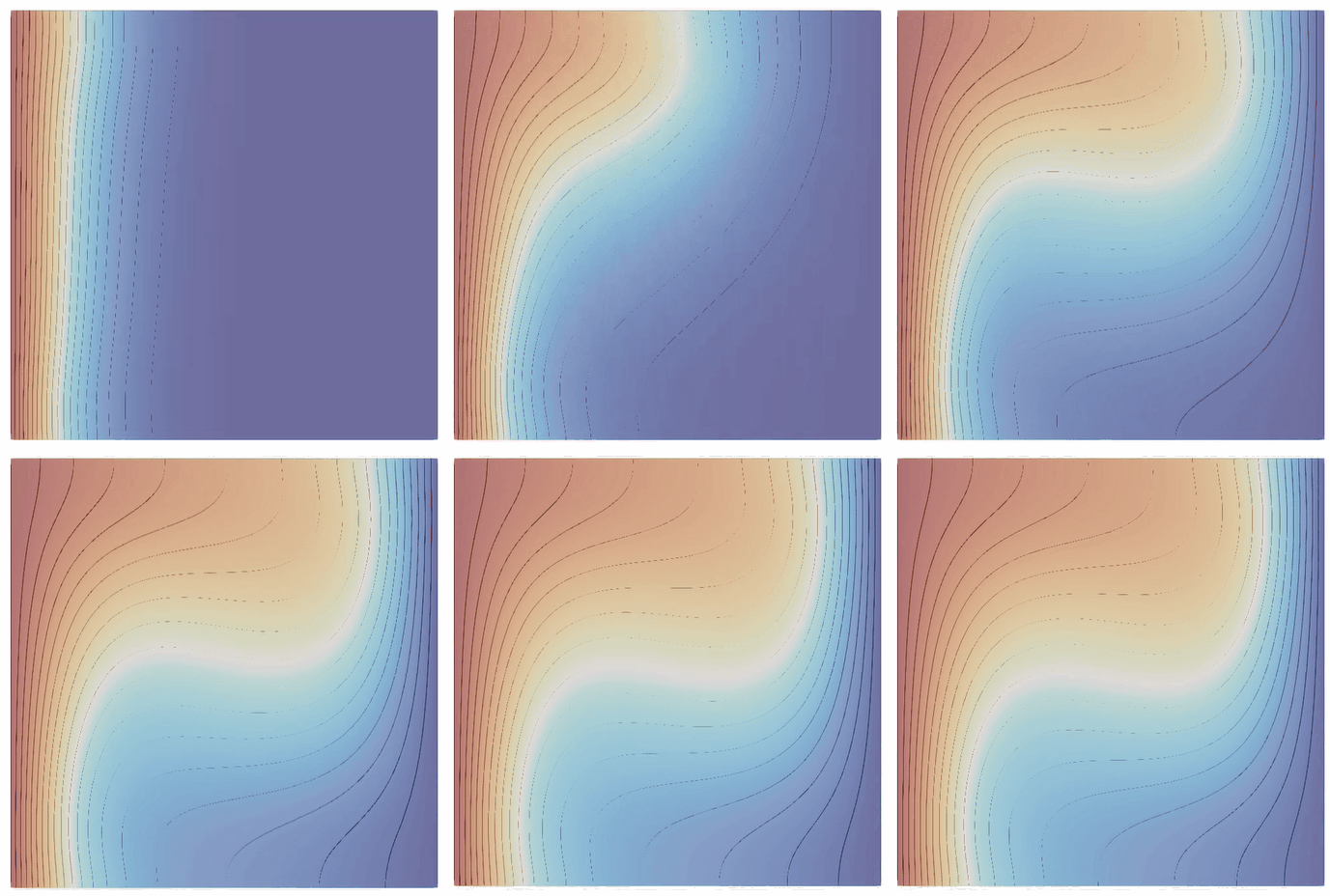
Heat was the issue, with previous designs literally catching fire.
I needed to up my game and knowledge of the tools.
Self-learning is lonely but worth it
That experience led me down a self-guided learning path, years after graduating.
University simply doesn’t (and can’t) prepare you for every project you’ll work on in the real world.
I came to learn that most CFD tools use FVM – a numerical method to calculate the trajectory of fluids based on forces etc. as sources of input.
If you missed my popular introductory post, take a look here:
We owe a lot to Calculus (so I learnt about it without a Math teacher)
In fluid dynamics (or indeed any dynamic situation), we’re only concerned with two things:
-
How fast is the quantity (velocity, temperature, movement etc) changing?
-
How much in total (over a given period in time) has it changed?
In Calculus, the branch of math that deals with this, the first is answered by something called a “derivative”. The second is called a “integral“.
A derivative looks at a quantity over a given area of time / space and returns a “slope” that numerically indicates the rate of the change.
An integral accumulates many of these changes over the bigger area.
That’s it. That’s really the basis of all CFD tools.
Sure, there’s a few details I’m leaving out…but I don’t want to swamp you to with too much math, but I do know when it’s practically useful.
To that end, I’m planning to detail more about these concepts as they are directly relevant.
Thanks for tuning in this week!
PS. If you’re struggling to learn or make real progress with OpenFOAM for CFD simulation, my manual ‘The OpenFOAM Diet’ has been a resounding success with readers! Click here for details. (And send me an email if you’re a student and I’ll send you a unique discount code for it.)
See you soon. 👋
Nasser
