
This is just WEIRD.
In simulation terms it’s known as result divergence – or the onset of a simulation “explosion”. In fact, the velocity readings went higher and higher as the iterations went on, confirming this!
It’s really frustrating.
And if you’ve ever spent time preparing the model, setting up the OpenFOAM solver and biting your nails waiting for the run to finish, you’ll know exactly what I mean.
Well, just know that It’s unlikely to be your computer misbehaving or you just having a bad day.
The very first thing you should do is double-check your boundary conditions – do they make physical sense?
I’ve written about this before so take a look at that post to set them up correctly in OpenFOAM:
Once you’ve made sure they’re realistic and plausible, keep reading on.
Trouble-shooting the issue
The case I’m simulating here is of an Air Intake Manifold.
In terms of the geometry, I have a single Inlet pipe going into a “plenum” chamber which then feeds into four, equally-positioned outlets.
The air is set to 5m/s going in to the main chamber and departing from each outlet.
We can investigate a number of metrics here.
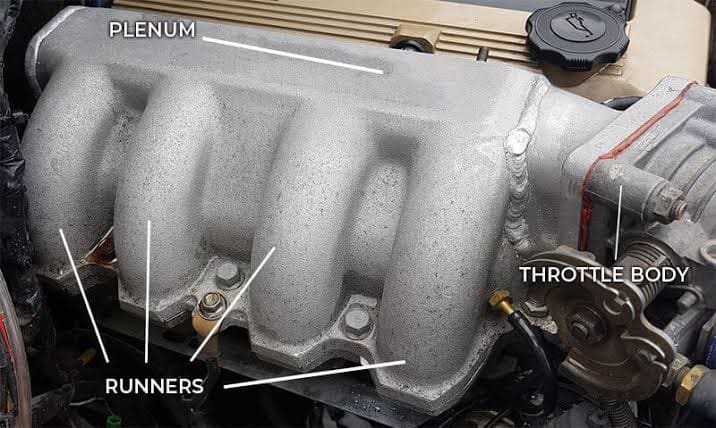
An Air Intake Manifold typically feeds the individual cylinders of an Engine with air, in the required amount and at the right time of the combustion cycle.
I chose to look at air flow distribution to the outlets and whether it was equally distributed. Even without measuring the actual mass flow rate / percentage, you should be able to visually appreciate the results above are incorrect.
In other words, we should expect the fundamental (and intuitive) flow behaviour to be exhibited with such a symmetric and simple setup.
Struggling to setup a clean case in OpenFOAM? Check out my manual I wrote to guide you:

Improved, stable results
Having dug around the documentation, code and other resources, I’ve come to the following solver settings that allow you to get your simulation running correctly if you’re seeing a similar result in your case.
It’s just incredibly time-consuming and quite challenging to get right, especially if you’re starting out with this tool.
Let me save you time and frustration.
Access my stable solver settings and case files below:
