
Most Engineers don’t share their specific workflow – I mean the little details that make all the difference.
Some go on to become really good at their job, but in my experience, only a few actually build repeatable frameworks and workflows for what they do.
Most absorb the skills from a mentor or go on autopilot.
That was me too…for years!
But I was following a workflow – I just hadn’t consciously and physically written it down!
In industry it makes all the difference to the output and quality of the work.
Here’s how every new CFD study should ideally be planned out:
Defining the [Engineering] objective
Building the physics concept
Planning the simulation itself
Checking available resources
Considering the risks
Documenting the plan
Together, these components of the workflow lead to a well-designed and orchestrated simulation study.
Here it is in one, clear and easy-to-reference info-graphic.
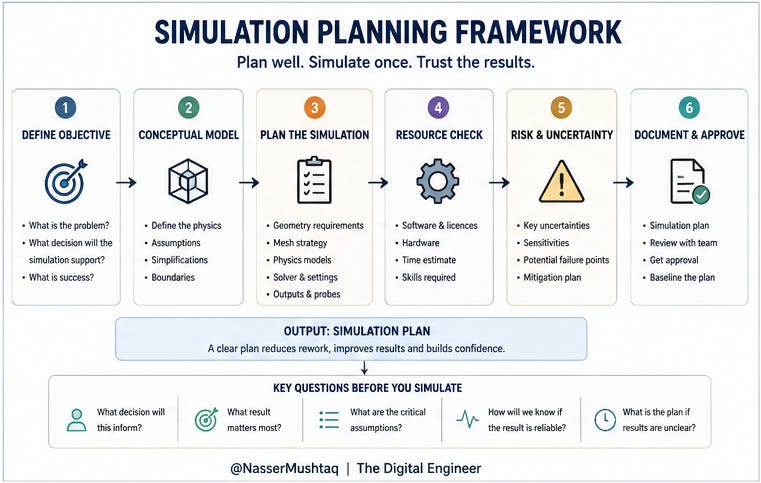
Something like this acts like a post-it note, reminding me what’s important and keeping me focused on the outcome.
And this is what really matters when it comes to Engineering work.
I’ve also hosted other frameworks on my “Resources” page of my website.
Take a look here: https://nasserm.com/resources/
I hope you study these and put it into practice.
See you soon. 👋
Nasser
